Hot Water Not Working in Quakers Hill? A Local Plumber’s Advice
| Quick answer: If your hot water is not working in Quakers Hill, the cause is usually one of four things: a tripped circuit or an off-peak supply that has not switched on, a gas pilot light or gas supply problem, a failed thermostat or element, or a tempering valve limiting the temperature at your taps. You can safely check the switchboard, the isolation valves and whether the pilot light is lit. Anything involving gas, electrical components or the pressure relief valve is work for a licensed plumber in Quakers Hill. Local Quakers Hill Plumber is on 02 9158 3597, 24 hours a day. |
What this guide covers
- Work out which hot water system you have
- Safe checks before you call a plumber in Quakers Hill
- Warm but never hot? Look at the tempering valve
- When no hot water becomes an emergency
- Repair or replace: how a local plumber decides
- Why Quakers Hill homes see certain faults
- Renting? Hot water is an urgent repair
- Frequently asked questions
It always happens on the coldest morning

You turn the tap, wait the usual few seconds, and nothing warms up. Or it runs hot for ninety seconds then goes cold halfway through a shower. It is one of those faults that moves from mildly annoying to genuinely disruptive inside a day.
The good news is that a fair share of hot water callouts turn out to be something small. A breaker has tripped. A pilot light has blown out. An isolation valve was knocked closed during other work and forgotten. Before you book a plumber in Quakers Hill, there are a few checks you can safely run yourself, and they take about five minutes.
Work out which hot water system you have
This matters more than people expect, because the fault list is different for each type. Go and look at the unit before anything else.
Electric storage. A tall cylinder, usually outside or in a laundry or garage. Many run on a controlled load or off-peak tariff, heating only during set overnight hours. If something interrupted that cycle, you find out at breakfast.
Gas storage. Also a cylinder, but with a flue on top and an access panel at the base where the burner and pilot sit. These reheat far faster than electric, so a gas tank that has gone cold and stayed cold usually points to a burner or gas supply issue rather than heavy use.
Continuous flow gas, also called instantaneous. A flat rectangular box on an external wall, no tank, heating water only as it flows. Common on newer builds and townhouses around Quakers Hill, Acacia Gardens and The Ponds. Most show an error code on a display, which is useful to have when you call.
Solar or heat pump. Solar pairs roof collectors with a tank and an electric or gas booster. Heat pumps look like a tank with a compressor attached. Faults can sit in the boost circuit, the controller or the pump.
Photograph the data plate while you are there. Brand, model and manufacture date tell a plumber a lot before anyone drives out.
| Not sure what you are looking at? Our guide to the common causes of no hot water in Quakers Hill homes runs through each system type with the symptoms that go with it. |
Safe checks before you call a plumber in Quakers Hill
Each of these can be done without tools and without opening anything sealed. If a check does not resolve the problem, stop there, because pushing further into a hot water unit is where people get hurt or void a warranty.
Electric storage
- At the switchboard, find the breaker labelled hot water, HWS or water heater, and reset it once. If it trips again immediately, leave it off and call: a breaker that will not hold usually means a failed element or water reaching an electrical component.
- Check whether the unit is on a controlled load tariff. If so, a tank drained by a long run of showers will not recover until the next overnight cycle. That is normal, not a fault.
- Look at the base of the tank and the ground around it. Pooling water, rust streaks or a constantly dripping relief valve shift things from repair to likely replacement.
Gas storage
- Open the access panel and look for the pilot flame. If it is out, follow the relighting instructions printed on the unit exactly.
- If the pilot lights then dies within a minute or two, do not keep relighting it. That is a specific and common fault pattern, covered in our guide to why a pilot light keeps going out on gas hot water systems.
- Try your other gas appliances. If the cooktop will not light either, the problem is the gas supply, not the water heater. On bottled LPG, check the bottle is not simply empty.
- If you smell gas, turn it off at the meter or bottle if you can do so safely, do not operate switches, and get everyone outside before you call.
Continuous flow gas
- Write down any error code. Codes are model specific and point a technician almost straight to the fault.
- Confirm the unit has power. Many continuous flow systems need mains power for their electronics even though they burn gas.
- Check the isolation valves at the unit are fully open. These get closed during other work and left that way.
Solar and heat pump
- Check the booster is switched on. After overcast days a solar system leans on its booster, and if that is off at the switchboard you run out.
- Listen for the compressor on a heat pump. Silence when it should be running is worth mentioning when you call.
Beyond this point, leave it alone. In New South Wales, gas fitting and the electrical components inside a hot water unit are licensed work for good reason, and the pressure and temperature relief valve is not something to test or adjust yourself.
Warm but never hot? Look at the tempering valve
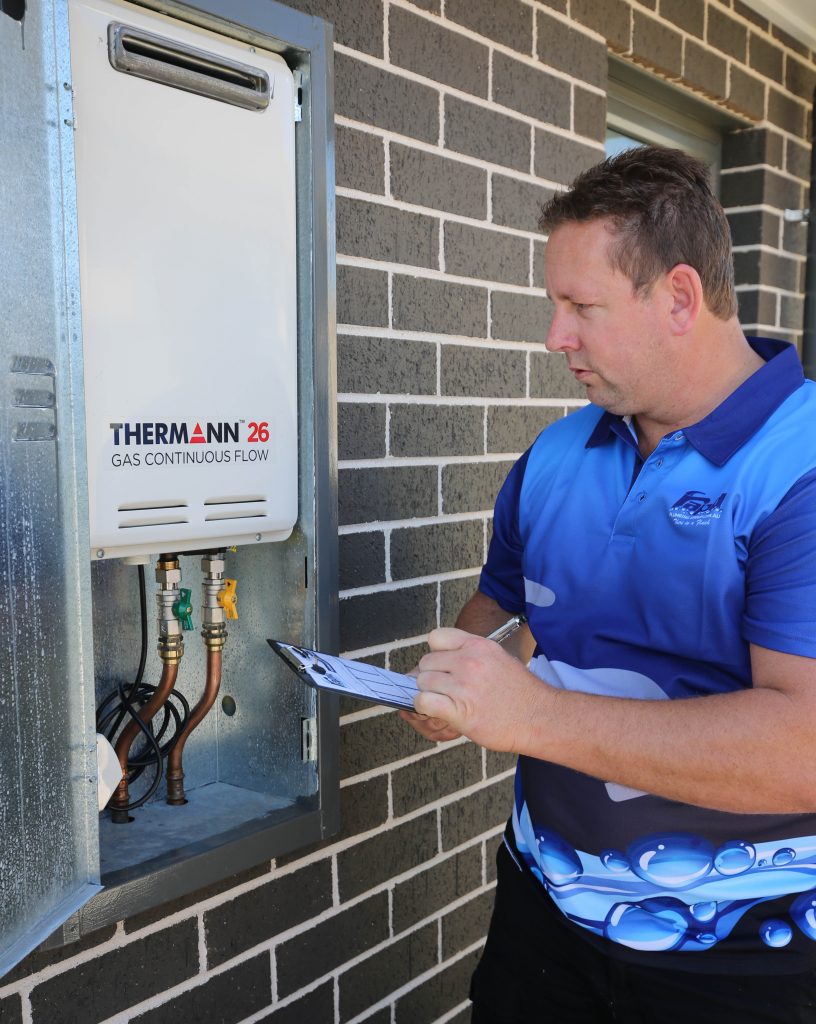
This one catches people out, because the system looks like it is working. Water arrives, it is warm, it just never gets properly hot at the bathroom.
Residential plumbing in New South Wales requires water at bathroom outlets to be limited to a safe temperature, managed by a tempering valve fitted near the unit. It blends hot water from the tank with cold to hold a scald-safe temperature. Like any mechanical valve it has a service life, and as it fails it commonly drifts toward the cold side. The tank is heating fine; the valve is no longer blending correctly.
A useful test: compare the kitchen tap with the shower. Kitchen and laundry outlets are typically not tempered, so a properly hot kitchen with a lukewarm shower makes the tempering valve a strong candidate. If every outlet is lukewarm, a drifting thermostat or partially failed element is more likely. Water that starts hot then turns cold mid-shower has its own causes, covered in why hot water runs warm and then cold in the shower.
When no hot water becomes an emergency
Most hot water failures can wait for a scheduled booking. Some cannot. Call straight away if you notice:
- Any smell of gas near the unit.
- Water pouring or streaming from the tank, rather than the occasional drip from the relief valve.
- Water pooling near an electrical outlet, the unit’s wiring or the switchboard.
- Scalding water at the taps, especially with young children or elderly residents at home.
- A circuit breaker that trips again immediately every time it is reset.
- Discoloured or foul-smelling hot water with a loss of pressure.
A leaking storage tank does not improve on its own. Once the cylinder has corroded through the leak grows, and waiting out the weekend can turn a straightforward replacement into water damage to a garage, wall cavity or flooring as well.
| Not sure whether it can wait? Better asked than guessed. Our emergency 24/7 plumbing service covers Quakers Hill around the clock, and a two-minute call is usually enough to tell you whether you have a problem for tonight or a problem for Tuesday. |
Repair or replace: how a local plumber decides
Once the fault is diagnosed, the next question is whether to fix the unit or replace it. A few factors carry most of the weight.
Age. Most glass-lined tanks reach a point where the cylinder has simply worn out. If a unit is well into its expected lifespan, a major component repair can mean paying twice inside a short window.
What actually failed. A thermostat, element, thermocouple or valve is generally a repair. A corroded cylinder that is leaking is not repairable, because the failure is the tank itself.
Anode condition. Storage tanks contain a sacrificial anode that corrodes in place of the steel, and once it is exhausted the tank itself starts corroding. Replacing an anode before that point can extend a tank’s life considerably, so it is worth asking about at a service visit.
Repair history and demand. A unit that has needed attention two or three times recently is telling you something. And if the family has grown, replacing like for like just recreates the shortfall, so have the sizing reviewed. Our guide on whether to repair or replace a hot water system in Quakers Hill goes deeper.
| Weighing up a replacement? Get an assessment and a clear quote before committing. Our hot water installation and repairs service covers gas, electric, solar and heat pump systems, and we will tell you honestly if the existing unit has life left in it. Call 02 9158 3597 to arrange a look. |
Why Quakers Hill homes see certain faults
Local housing stock shapes the callouts. Quakers Hill mixes established homes from the eighties and nineties with newer estates around Acacia Gardens, The Ponds and Schofields, and that produces two distinct patterns. In the older homes we see original or first-replacement storage units quietly reaching the end of their service life, and the failure is rarely dramatic at first: hot water gets less reliable, showers run shorter, then one morning the tank has failed.
In the newer estates continuous flow gas dominates and the faults look different. Electronic ignition problems, error codes, blocked or poorly positioned flues, and units sized for the original build rather than the household living there now. A system that cannot handle two showers at once is usually a sizing issue, not a breakdown. Sydney’s water is also relatively soft compared with many Australian cities, so the heavy scaling that destroys elements elsewhere matters less here than corrosion and component wear. Winter cuts the other way: colder incoming mains water makes every system work harder, and marginal units that coped through summer start showing their age.
Local Quakers Hill Plumber works throughout the suburb and neighbouring areas, with full coverage on our Quakers Hill service area page. Anything involving the burner, gas line or LPG connection is carried out under our licensed gas fitting and LPG service.
Renting? Hot water is an urgent repair
Under New South Wales residential tenancy law, the failure of an essential service provided for hot water is an urgent repair. That classification changes what your landlord or agent must do, and how quickly.
Notify the landlord or managing agent immediately, in writing as well as by phone so there is a timestamped record. If they cannot be reached and do not arrange a repair, tenants may in certain circumstances organise an urgent repair and seek reimbursement, subject to a cap and conditions in the legislation. Those thresholds can change, so confirm the current position with NSW Fair Trading first and keep every invoice and message.
Key takeaways
- Identify your system type first. Electric storage, gas storage, continuous flow and solar or heat pump all fail differently.
- Safe checks: the switchboard breaker, controlled load tariff, the pilot light, other gas appliances, any error code, and the isolation valves.
- Warm but never hot, with a properly hot kitchen tap, often points to a failing tempering valve rather than the heater.
- Gas smells, running water from the tank, water near electrics, scalding taps and a breaker that will not hold all mean call now.
- Repair or replace comes down to age, what failed, anode condition, repair history and whether the system still suits the household. Do not open the unit, adjust the relief valve, or attempt gas or electrical work, because in New South Wales that is licensed work.
| Still no hot water? Let’s get it sorted today. Local Quakers Hill Plumber serves Quakers Hill and the surrounding Blacktown suburbs, with licensed plumbers available 24 hours a day for hot water breakdowns. We diagnose the fault, explain what we find in plain language, and quote before we start. Call 02 9158 3597 now, or get in touch through our contact page and we will call you back. |
Frequently asked questions
Why did my hot water stop working overnight with no warning?
The usual overnight culprits are a tripped circuit breaker, a pilot light that has blown out, or an interrupted off-peak heating cycle. It is also possible the tank has leaked and drained. Check the switchboard and the ground around the unit first, because a wet patch changes the diagnosis.
How long should a hot water system last?
It depends on the type, the quality of the unit, and whether it has been serviced. Storage tanks generally have a shorter working life than continuous flow units, and a tank whose sacrificial anode was never replaced tends to fail earlier. Have an ageing unit inspected rather than relying on a fixed number.
Can I relight the pilot light myself?
Yes, if the manufacturer’s instructions are printed on the unit and you follow them exactly. If the pilot will not stay lit, stop and call a licensed plumber. Repeated failure usually means a faulty thermocouple, a gas supply problem or a flue issue, none of which relighting fixes.
My water is warm but never hot. Is the whole system broken?
Not necessarily. Check whether the kitchen tap runs properly hot. Kitchen and laundry outlets are usually not tempered, so a hot kitchen with a lukewarm shower points to a failing tempering valve, which is a comparatively contained repair. If every outlet is lukewarm, the thermostat or element is more likely.
Do I need an emergency plumber, or can it wait until tomorrow?
Call immediately if you smell gas, if water is running rather than dripping from the unit, if there is water near electrical fittings, if the taps are scalding, or if a breaker trips every time you reset it. If nothing is leaking, it can generally wait for a scheduled booking.
Who pays for hot water repairs in a Quakers Hill rental?
In a New South Wales tenancy this is ordinarily the landlord’s responsibility, and it is treated as an urgent repair. Report it in writing straight away. If the landlord or agent cannot be reached and does not arrange the repair, tenants may be able to organise one and seek reimbursement within limits set by the legislation.