Above-Ground vs Underground Rainwater Tank Installation
| Quick answer: The main difference in rainwater tank installation is where the water sits and what it costs to put it there. Above-ground tanks are cheaper, faster to install, and easy to inspect, but they take up yard space and usually need a pump for household use. Underground tanks free up your entire yard and hold larger volumes, but they require excavation, a submersible or suction pump, and more careful planning around soil, drainage, and access. For most Quakers Hill homes on a standard block, an above-ground slimline tank is the practical starting point. Underground makes sense when yard space is genuinely unavailable or you need a large storage volume. |
What this guide covers
- What rainwater tank installation actually involves
- Above-ground tanks: where they win and where they don’t
- Underground tanks: where they win and where they don’t
- Side by side for a typical Quakers Hill block
- Cost, access, and long-term maintenance
- Approvals and plumbing compliance in NSW
- How to choose, and what to ask your plumber
- Frequently asked questions
Deciding before you dig
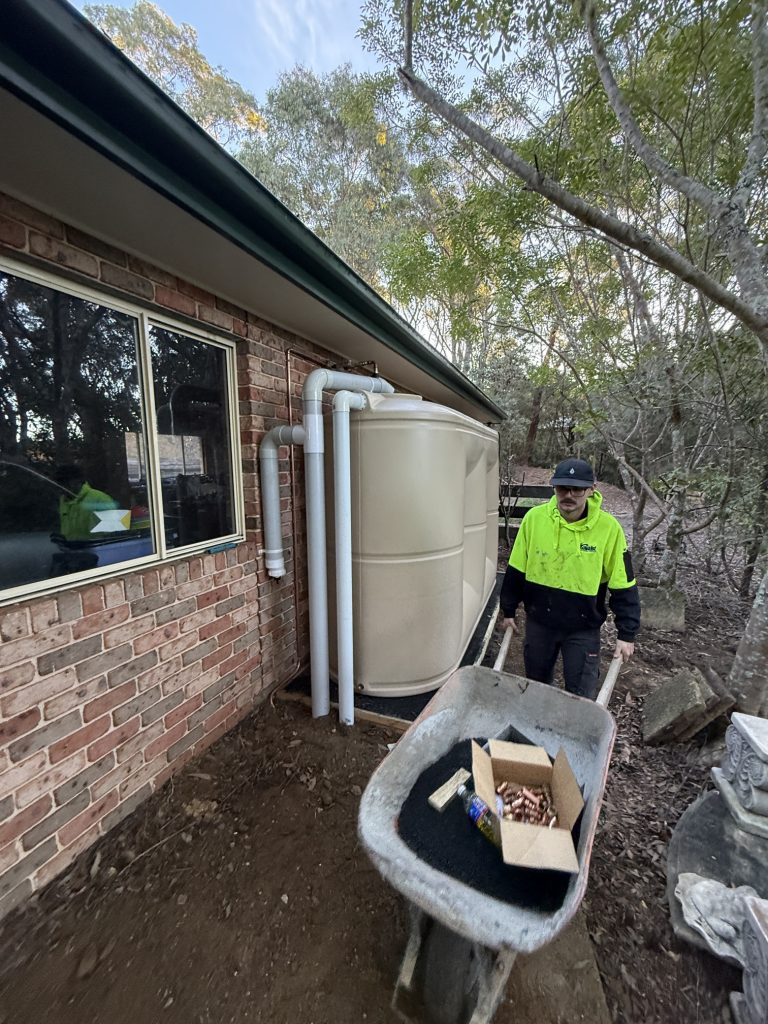
Most people come to rainwater tank installation from one of two directions. Either the water bill has crept up and the garden is drinking most of it, or a new build or renovation has triggered a water-efficiency requirement that a tank happens to satisfy. Either way, the first real decision is not brand or capacity. It is whether the tank sits on the ground or under it.
That single choice drives almost everything else: what the site work costs, whether you need a pump, how easy the tank is to clean in five years, and how much of your yard you get to keep. It is also the hardest decision to reverse. Moving a poly tank across the yard is a morning’s work. Moving an underground tank is not.
In Quakers Hill the calculation has a local flavour. Newer estates tend to pair generous houses with modest yards, which pushes homeowners toward slimline above-ground tanks tucked down the side. Older blocks with more room, or properties where the landscaping is already locked in, are where underground starts to look attractive. Western Sydney’s reactive clay soils matter more than people expect once excavation enters the picture.
| Still weighing it up? If you are at the research stage, it helps to see what the installation actually includes before you compare quotes. Our overview of rainwater tank and pump installation walks through the scope of work, and our earlier post on things to consider for water tank installation covers sizing and site selection in more detail. |
What rainwater tank installation actually involves
Whichever type you choose, a compliant install has the same core parts. Understanding them makes quote comparison far easier, because a cheap quote is usually cheap because something in this list is missing.
- Catchment and downpipe work. Roof water is redirected into the tank, usually by cutting into existing downpipes and running charged or gravity lines to the inlet.
- First-flush and leaf diversion. A diverter dumps the dirtiest initial runoff and a strainer keeps debris out. Skipping these is the fastest route to sludge and smell.
- Overflow. Excess water has to go somewhere legitimate, normally back to stormwater. An overflow discharging next to the slab creates a damp problem later.
- The base or excavation. Above-ground tanks need a level, properly compacted base. Underground tanks need excavation, bedding, and backfill to the manufacturer’s specification.
- Pump and pressure. Anything beyond a gravity-fed garden tap needs a pump sized to the demand.
- Connection to the house. Plumbing tank water to toilets, laundry, or outdoor taps is licensed work and needs backflow protection.
That last point is not optional or negotiable. Connecting a tank to household fixtures is regulated plumbing work in NSW and needs a licensed plumber. The same principle applies to any renovation work involving a licensed plumber: the certificate of compliance protects you at resale and with insurance.
Above-ground tanks: where they win and where they don’t
Above-ground is the default for a reason. It is simpler, it is cheaper, and if something goes wrong you can see it.
The advantages
- Lower installed cost. No excavation, no spoil removal, no engineered backfill. Site preparation is a compacted crushed rock pad or a small slab.
- Fast installation. A straightforward install is often a one-day or two-day job once the base has cured, assuming simple downpipe runs.
- Easy inspection. You can open the lid, check the level, and see a leak the day it starts. That matters more than it sounds.
- Simple maintenance. Sediment removal, first-flush servicing, and pump swaps are all surface-level jobs.
- Slimline options. Slimline poly and steel tanks are built for narrow side passages, which suits newer Quakers Hill homes where the side setback is the only spare ground.
- Gravity feed is possible. A well-positioned tank can supply a garden tap without a pump, though the pressure will be modest.
The trade-offs
- It occupies yard space. Even a slimline tank has a footprint, and a round tank of real capacity can dominate a small backyard.
- Visual impact and exposure. Colorbond-style tanks blend better than translucent poly, which can also encourage algae if light gets through. Sun and UV work on a tank year round, and a cheap one in full western sun will show its age.
- Capacity ceiling. There is a practical limit before the tank becomes the dominant feature of the yard.
- Base failure risk. An underprepared base is the most common above-ground problem. A full tank is extremely heavy, and an unevenly settling pad can distort or split it.
Underground tanks: where they win and where they don’t
Underground tanks solve the space problem completely, and for some properties that is the whole argument. But they front-load a lot of cost and complexity.
The advantages
- The yard stays yours. Once backfilled and finished, the space above the tank can usually be lawn or garden. Some tanks are rated for driveways or parking, but that is a specific product with a specific installation spec, not an assumption you can make.
- Larger volumes are practical. Because the tank is not competing for visible space, you can store considerably more water without it dominating the property.
- Stable, shaded water. Below ground the water stays cooler and out of sunlight, which helps limit algae growth, and the tank itself is shielded from sun, hail, and impact.
- No visual impact. Only the access lid and the pump housing are visible.
The trade-offs
- Excavation is the cost driver. You are paying for machinery, access, spoil removal, bedding, and backfill. Rock, reactive clay, or a tight rear yard with no machine access all push the price up.
- Services have to be located first. Sewer, water, gas, electricity, and telecommunications all need identifying before anyone breaks ground. That is non-negotiable and adds a step.
- You will need a pump. Gravity works against you, so installs use a submersible pump inside the tank or an external pump drawing from it. That means an electrical supply and a running cost.
- Harder to inspect and maintain. Sediment still accumulates, cleaning is a bigger job, and confined-space considerations can apply.
- Water table and flotation. An empty tank in saturated ground can be pushed upward. Manufacturers specify anchoring or ballast requirements for exactly this reason.
- Leak detection is harder. A slow leak underground can go unnoticed. This is the same challenge that makes buried pipe faults tricky, and it is why non-invasive leak detection exists as a specialty in the first place.
Side by side for a typical Quakers Hill block
| Factor | Above-ground | Underground |
| Installed cost | Lower | Significantly higher |
| Installation time | Short | Longer, weather dependent |
| Yard space used | Yes, footprint remains | Effectively none once finished |
| Pump required | Sometimes | Almost always |
| Ease of inspection | High | Limited |
| Maintenance access | Straightforward | More involved |
| Practical capacity | Constrained by space | Larger volumes feasible |
| Visual impact | Visible | Concealed |
| Site risk factors | Base preparation | Soil type, services, water table |
For a standard suburban block where the side passage is free and the budget is finite, above-ground wins on nearly every practical measure. The case for underground gets stronger when the yard is small and fully landscaped, when the property already has hardscaping you do not want to lose, or when the water demand is high enough that a large volume genuinely pays for itself.
| Comparing quotes? Ask each installer to break out the site preparation, the pump, the downpipe and overflow work, and the compliance connection separately. Two quotes that look similar on the total can differ enormously in what they include. If you would like a site assessment for your property, our team can look at access, soil, drainage, and roof catchment before you commit to a tank type. Get in touch through our contact page. |
Cost, access, and long-term maintenance

Rather than quoting figures that vary wildly by site, it is more useful to understand what actually moves the price on a rainwater tank installation.
Access is the underrated one. If a machine can reach the excavation area, an underground install becomes far more feasible. If everything has to come through a 900mm side gate, the labour component climbs sharply for both tank types. Soil matters next: Western Sydney clay is workable but heavy and holds water, rock is worse, and a soil assessment before quoting saves everyone from a mid-job variation.
Distance from downpipes drives the pipework, and charged line systems need to be set out correctly to drain and self-clean. Pump specification is the last big variable: a pump sized for a garden tap is not the same as one feeding two toilets, a laundry, and irrigation, and undersizing is a false economy.
Ongoing maintenance is genuinely modest for either type, but it is not zero. Gutters need clearing so leaf litter does not wash into the system, first-flush devices need periodic checking, inlet strainers need cleaning, and sediment builds up over the years and eventually needs removal. Neglecting the gutter side of the equation is a common cause of grief, and it overlaps with the same conditions that cause blocked drains after heavy rain. If your stormwater already struggles in a downpour, sort that out before you add a tank to the system. Our blocked drain services cover that side of things, and the Quakers Hill homeowner’s plumbing checklist is a useful seasonal prompt.
Approvals and plumbing compliance in NSW
Requirements vary by property and by council, so treat this as orientation rather than as approval advice. Confirm the specifics for your address before you order a tank.
In New South Wales, many domestic rainwater tanks can be installed as exempt development, meaning no development application is needed, provided the install meets conditions covering size, siting, setbacks, and overflow disposal. Those conditions are real limits, not formalities, and an underground tank or one in a front setback is more likely to fall outside them. Blacktown City Council is the consent authority for Quakers Hill, so confirm with them what applies to your block.
On the plumbing side, the connection work is governed by the national plumbing standards and NSW regulation. The parts that matter most to homeowners:
- Any connection between tank water and household plumbing must include appropriate backflow prevention so tank water cannot enter the drinking water supply.
- Tank water outlets and any non-drinking water taps need to be clearly identified.
- Overflow must discharge to an approved stormwater point, not to a neighbouring property or against your own footings.
- The work must be carried out by a licensed plumber, and you should receive a certificate of compliance.
If the tank is part of a new build or major renovation, the water-efficiency requirements attached to your approval may also dictate minimum tank size and which fixtures it supplies. Check that before choosing a tank.
How to choose, and what to ask your plumber
Key takeaways:
- Start with your roof catchment and your actual water demand. A tank you cannot fill is wasted money, and so is one that runs dry every February.
- If you have usable side or rear space, above-ground is almost always the better value.
- Choose underground when space is genuinely the constraint, when you need larger storage, or when the finished appearance matters enough to justify the cost.
- Budget for the whole system, not the tank. Pump, base or excavation, downpipe work, first flush, overflow, and the compliance connection are all part of the job.
- Get the base right. It is the cheapest part of the install to do properly and the most expensive to fix later.
- Have the services located before any excavation, every time.
- Confirm council requirements for your address before ordering.
Good questions for any installer: what base or excavation specification are you using and why, what pump are you quoting and for what demand, where does the overflow go, is the connection work included with a compliance certificate, and how do I access the tank for cleaning in five years? A tank is a long-term piece of infrastructure attached to your roof and your plumbing, so it is worth an hour of questions up front.
Frequently asked questions
Do I need council approval for a rainwater tank in Quakers Hill?
Many domestic tanks in NSW can be installed as exempt development if they meet the relevant conditions on size, position, setbacks, and overflow. Underground tanks and tanks in unusual positions are more likely to need approval. Because it depends on your specific block, confirm with Blacktown City Council before you order.
Is an underground rainwater tank worth the extra cost?
It can be, if space is your real constraint. If you have no usable yard for a tank, or you want a large storage volume without giving up the garden, the extra cost buys something above-ground cannot offer. If you have a free side passage and a standard water demand, an above-ground slimline tank will usually deliver the same practical benefit for considerably less.
Can I connect a rainwater tank to my toilet and laundry?
Yes, and it is one of the better uses for tank water because the demand is steady year round. The connection must be done by a licensed plumber with proper backflow prevention, and the tank water outlets need to be identified. This is regulated work, not a DIY job.
How much maintenance does a rainwater tank need?
Less than most people fear, but not none. Keep gutters clear, check the first-flush diverter and inlet strainer periodically, inspect the pump occasionally, and plan on sediment removal every few years. Underground tanks need the same attention with more effort involved in getting to them.
Can an underground tank move or float?
It can, if it is empty or near-empty and the surrounding ground becomes saturated. This is a known condition and manufacturers specify anchoring, ballast, or backfill requirements to prevent it. Following the installation specification exactly is what keeps it from happening.
What size rainwater tank should I get?
It depends on your roof catchment area, local rainfall patterns, and what you intend to use the water for. Garden-only use needs far less than a tank plumbed to toilets and laundry. Rather than guessing, work it out from your roof area and intended demand, or have it calculated as part of a site assessment.
| Ready to get a rainwater tank installed properly? Local Quakers Hill Plumber has been handling rainwater tank installation, pump work, and stormwater connections across Quakers Hill and the surrounding suburbs for years. We will assess your site, tell you honestly whether above-ground or underground makes sense for your block, and give you a quote that includes the whole system rather than just the tank. Call 02 9158 3597 to talk it through, or browse our rainwater tank pump repairs and installation service page. We also cover general plumbing and 24/7 emergency plumbing if something needs attention sooner. |