Rainwater Tank Installation: Sizing a Tank for Your Roof and Block
| Quick answer: To size a rainwater tank, multiply your connected roof area in square metres by your average annual rainfall in millimetres, then multiply the result by about 0.85 to allow for losses. That tells you roughly how many litres your roof can harvest in a year. Storage capacity is a separate question: pick a tank that covers the dry stretches between decent falls of rain, which for most Quakers Hill homes lands between 2,000 and 10,000 litres depending on block size and what you plumb it to. In NSW, an above ground tank of 10,000 litres or less can often be installed as exempt development, provided the installation meets every condition in the Codes SEPP. |
What this guide covers
- Start with the two numbers that matter
- Work out what you will actually use
- Matching the tank to your block
- Common tank sizes and what they suit
- Approvals and plumbing rules in NSW
- What a proper installation looks like
- Mistakes that make a good tank underperform
- Frequently asked questions
Most people start thinking about rainwater tank installation the same way: a big water bill lands, or the garden cooks through a dry February. Then the research starts and the advice gets vague fast. Tank suppliers quote capacity. Council pages quote setbacks. Nobody explains how the roof, the block and the household actually connect.
Sizing is not guesswork. There is real arithmetic behind it, and it needs only two inputs you can work out in an afternoon. Get those right and the rest, tank shape, position, pump and plumbing, follows naturally. Here is the method, the site constraints that rule out half the options on a typical Quakers Hill block, and the NSW rules that decide whether you need approval.
Start with the two numbers that matter
Everything begins with supply. One millimetre of rain falling on one square metre of roof produces one litre of water. That single relationship is the whole basis of tank sizing.
Measuring your connected roof area
Use the footprint of the roof, not the sloped surface. Rain falls vertically, so a steeply pitched roof catches the same volume as a flat one covering the same ground. Measure the outline of the house from above, including eaves, and you have your figure in square metres.
The word doing the heavy lifting is connected. Only the roof sections draining into downpipes you actually plumb to the tank count. A four bedroom home might have 220 square metres of roof and six downpipes, but if only two of them reach the tank you are harvesting perhaps a third of what the roof produces. Deciding early which downpipes get redirected often shifts where the tank should go.
Choosing a rainfall figure
Published annual averages for the Blacktown area sit somewhere in the range of 700 to 900 millimetres depending on the station and reference period, so look up the Bureau of Meteorology figure for the station nearest you rather than leaning on a rule of thumb. Rainfall here is also seasonally lopsided, with late summer and autumn delivering the heaviest falls and winter running drier. That pattern matters more for sizing than the annual total does.
Putting it together
Roof area (m²) × annual rainfall (mm) × 0.85 = litres harvested per year
The 0.85 is a runoff coefficient, accounting for water that never reaches the tank: splash out of the gutters in heavy downpours, evaporation off a hot roof in light showers, and whatever the first flush device diverts. Some designers use 0.8 to be conservative. Either way, do not plan around the full theoretical figure.
Connect 150 square metres of roof, use 750 millimetres of rainfall, and you get roughly 95,600 litres a year. That is a genuinely useful volume. It is also spread across twelve months and delivered in irregular bursts, which is why the next question matters.
| Still weighing up whether a tank suits your place? Have a look at our guide to things to consider before a water tank installation for the practical questions worth settling before you start comparing prices. |
Work out what you will actually use
Supply tells you how much water is available. Demand tells you how much storage you need. Conflating the two is why people end up with a tank that is either half empty or constantly overflowing. Start by deciding what the tank will feed:
- Garden and outdoor taps only. Simplest setup, but demand peaks in exactly the months that tend to be driest.
- Toilet flushing. Steady year round demand regardless of weather. This is where a tank earns its keep on the water bill.
- Cold water to the laundry. Adds meaningful volume in a busy household.
- Pool top ups, car washing, water features. Intermittent but occasionally large draws.
You can estimate demand more accurately than most people assume. Check the WELS star rating on your toilet suite and washing machine, count the flushes and loads in a typical week, and add a rough figure for summer garden watering.
Then apply the principle that actually governs storage: your tank needs to bridge the gap between decent falls of rain, not store a year of supply. A reasonable target for most Sydney homes is enough capacity to cover three to six weeks of the demand you are connecting. Longer if it feeds only the garden and you want it to survive a dry spell. Shorter if it feeds toilets and laundry and refills often.
Matching the tank to your block
This is where the theoretical answer meets a suburban lot, and where a lot of plans get redrawn.
Space, shape and setbacks
Newer estates around Quakers Hill, Stanhope Gardens and The Ponds tend to run to narrow side passages and compact rear yards. A 5,000 litre round poly tank needs roughly a two metre diameter footprint and stands well over two metres tall, which is often a non starter down the side of a house. Slimline tanks solve this: typically 300 to 600 millimetres deep, sitting flush against a wall or fence line, in capacities from around 600 litres to 5,000 litres. Two or three linked slimlines frequently beat one round tank on both capacity and appearance. Older blocks with deeper backyards have more freedom, and a single larger round tank is usually cheaper per litre.
Access, easements and overflow
Before settling on a position, check three things: whether the tank can physically reach the spot given gates, fences and side passage width; whether a sewer or drainage easement runs through the yard, since building over one generally needs the water authority’s approval; and where the nearest stormwater connection sits.
That last point catches people out. An overflow discharging into the yard creates a permanent boggy patch and can push water onto a neighbour’s land. It needs to tie into the existing stormwater system, which sometimes means the tank sits where the drainage suits rather than where the aesthetics do. If your stormwater already struggles in heavy rain, resolve that first, and our blocked drain and stormwater clearing service is the place to start.
The base
A full 5,000 litre tank weighs five tonnes. Poly tanks need a level, stable base of compacted crusher dust or a concrete pad, sized to support the entire footprint. Skimping here is how tanks lean, crack, or split a fitting eighteen months in.
Common tank sizes and what they suit
| Capacity | Typical form | Suits |
|---|---|---|
| 600 to 1,500 L | Slimline or under deck | Courtyards and townhouses. Garden use, occasional car washing. |
| 2,000 to 3,000 L | Slimline against a side wall | Standard newer blocks. Garden plus one indoor connection. |
| 5,000 L | Round or twin slimline | Family homes with reasonable yard space. Toilets, laundry and garden. |
| 10,000 L | Round, rear yard | Larger blocks and higher demand. The usual ceiling for exempt development. |
| Above 10,000 L | Round or modular | Acreage and rural properties. Generally needs council consent. |
If you are close to a threshold, size up rather than down. A larger tank costs little more once the installation is priced in, and a tank that overflows a few times a year is doing its job. One that runs dry every February is not.
Approvals and plumbing rules in NSW
Most residential rainwater tank installation in Quakers Hill falls under exempt development, meaning no development application is needed. That exemption is conditional, and the conditions are specific. Under the State Environmental Planning Policy (Exempt and Complying Development Codes) 2008, an above ground tank generally needs to:
- hold no more than 10,000 litres;
- sit at least 450 millimetres from each lot boundary if it stands more than 1.8 metres above ground level;
- avoid cut or fill deeper than one metre;
- be fitted with a screened rain head to keep leaf litter out;
- include a first flush device with a resetting valve, so the initial dirty runoff bypasses the tank;
- be mosquito proofed;
- have its overflow connected to existing stormwater, without discharging onto adjoining property;
- house any pump in a soundproofed enclosure.
Heritage items, environmentally sensitive land and some zonings carry extra requirements, so confirm your situation with Blacktown City Council if anything about the property is unusual.
The plumbing side has its own rules. Connecting a tank to internal fixtures such as toilets or the laundry is regulated work under AS/NZS 3500, must be done by a licensed plumber, and needs an appropriate backflow prevention device wherever the system interfaces with the mains supply. Trickle top up and automatic mains switching devices both fall into that category. New builds and major renovations add one more layer, BASIX, where the certificate specifies a minimum tank capacity and which fixtures it must serve. If you are building, the certificate dictates the size rather than the other way round.
| Not sure which rules apply to your block? Our team handles rainwater tank and pump installation across the district and can assess your roof, yard and stormwater in one visit, then tell you plainly what is straightforward and what needs approval. Request a quote and we will come and look. |
What a proper installation looks like
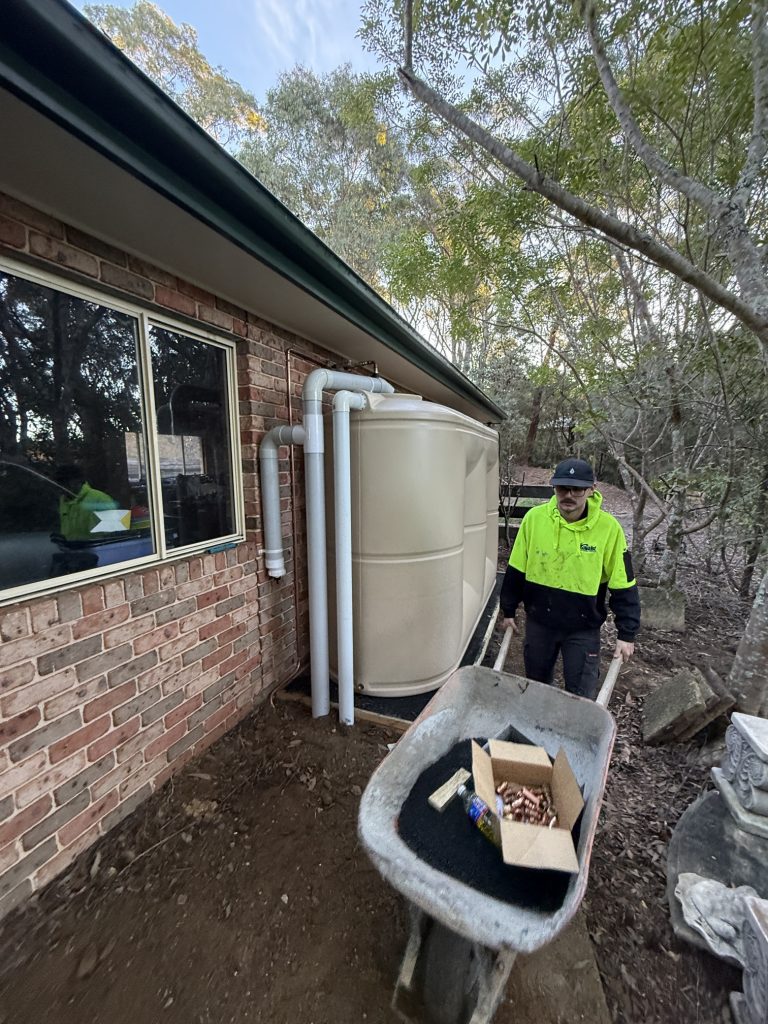
A tank sitting in the yard is not the same as a working rainwater system. A complete installation covers:
- Base preparation. Level, compacted, and sized for the full tank footprint.
- Downpipe modification. A dry system runs above ground straight into the tank inlet. A charged or wet system runs underground and rises into the tank, letting you collect from downpipes on the far side of the house. Charged lines must be sealed, with a drain point at the low spot.
- Rain heads and first flush diverters. The rain head screens leaves at the gutter; the diverter sends the dirtiest initial runoff away. Both need to stay reachable for maintenance.
- Overflow. Sized for a full downpipe flow and connected to stormwater.
- Pump and switching. Most homes need a pump for useful pressure. If the tank feeds toilets or laundry, an automatic switching device changes over to mains when the tank empties.
- Internal connections. Dedicated pipework to the fixtures supplied, with backflow protection and correct labelling of non drinking outlets.
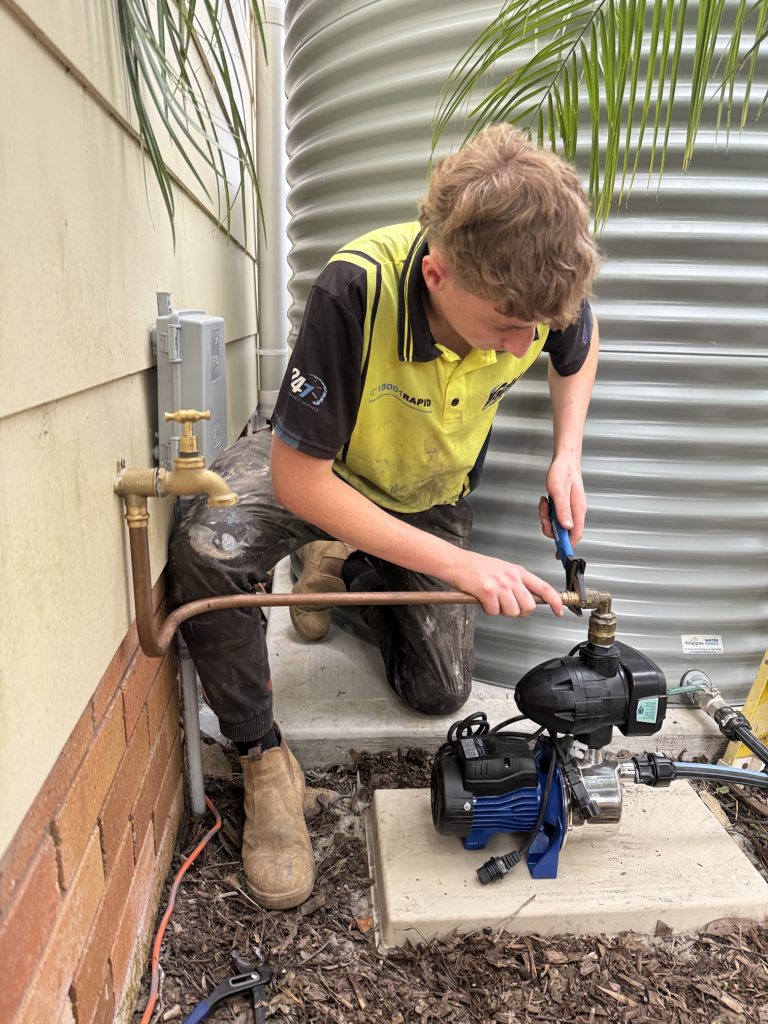
Pumps are the component most likely to need attention later. An oversized pump short cycles and wears out; an undersized one leaves disappointing pressure at the far end of the garden. Match it to the number of outlets and the head height, and give it a shaded, ventilated, sound insulated spot. Pump faults and pressure drops are among the more common calls we get, usually alongside broader general plumbing maintenance.
Mistakes that make a good tank underperform
- Connecting too little roof. The most common issue by far. A 5,000 litre tank fed by one downpipe on a small roof section will rarely fill.
- Sizing to the annual total instead of the dry gap. Annual harvest is a supply figure. Storage is about surviving the weeks in between.
- Skipping the first flush device. A small component that protects water quality, and a condition of the NSW exemption anyway.
- Neglecting gutters. Blockages upstream send the harvest over the edge instead of into storage, and can back water into the eaves.
- Ignoring the overflow. Discharging into the yard is a drainage problem waiting to happen, and a possible dispute with the neighbours.
- Leaving the tank out of the maintenance routine. Inlet screens, first flush chambers and pump filters need occasional attention, and sediment builds up over the years.
Key takeaways
- One millimetre of rain on one square metre of roof equals one litre. Everything follows from that.
- Use roof footprint area, and count only the downpipes you will actually connect.
- Apply a runoff factor of about 0.85 to the theoretical yield.
- Size storage to bridge three to six weeks of connected demand, not a year of supply.
- Block shape usually decides tank shape: slimlines for narrow lots, round tanks for deeper yards.
- Ten thousand litres is the usual ceiling for exempt development on an above ground tank in NSW.
- Any connection to internal fixtures is licensed plumbing work and needs backflow protection.
Frequently asked questions
What size rainwater tank do I need for a standard Quakers Hill home?
For a typical three or four bedroom home connecting the garden plus toilets, a tank in the 3,000 to 5,000 litre range usually balances useful storage against available space. On a narrow block, two linked slimlines often deliver that capacity more neatly than one round tank. Larger blocks with higher demand can justify 10,000 litres, which is also where exempt development limits start to bite.
Do I need council approval for a rainwater tank in NSW?
In many cases no. An above ground tank of 10,000 litres or less can generally be installed as exempt development under the Codes SEPP, provided it meets every condition, including boundary setbacks, first flush and rain head fittings, mosquito proofing and a proper stormwater overflow connection. Heritage listed properties, environmentally sensitive land and larger tanks are treated differently, so check with Blacktown City Council if your situation is not straightforward.
Can rainwater be used for drinking in Quakers Hill?
Where town water is available, health authorities generally recommend using the mains supply for drinking and cooking. Rainwater suits gardens, toilets, laundry and outdoor use well. Drinking tank water requires appropriate filtration, treatment and ongoing testing, and roof material and surroundings both matter.
How much can a rainwater tank save on water bills?
It depends on what you connect and how much you use. Toilets and laundry produce year round savings because that demand does not stop when the weather turns. A garden only tank saves less in dollar terms but can matter a lot during watering restrictions. A plumber can estimate this once they know your roof area, tank size and connected fixtures.
How long does a rainwater tank installation take?
A straightforward garden only installation on a prepared base is often a one day job. Adding downpipe redirection, a charged underground line, a pump with mains switching and internal fixture connections can stretch it across two or three days, particularly if trenching is involved.
| Ready to get a tank in the ground? Local Quakers Hill Plumber installs and services rainwater tanks and pumps across Quakers Hill and the surrounding suburbs. We will size the system to your roof and block, handle the downpipe and stormwater work properly, and make every fixture connection to standard. Call 02 9158 3597, or book through our rainwater tank and pump installation page. If something has already gone wrong with an existing tank, pump or overflow line, our emergency plumbing team is available around the clock. |