Rainwater Tank Installation Mistakes That Ruin Water Quality
| Quick answer: Most rainwater quality problems are not caused by the rain. They are built into the system during rainwater tank installation. The usual culprits are an uninspected roof catchment, a missing or neglected first flush diverter, unscreened inlets and overflows that let in light, insects and vermin, an outlet drawing from the sludge layer at the base of the tank, and a mains top-up connected without approved backflow protection. Getting these details right at installation is far cheaper than fixing cloudy, smelly or unsafe water later. |
On this page
- Why installation decides your water quality
- Mistake 1: Harvesting from a roof nobody inspected
- Mistake 2: No first flush diverter and no screens
- Mistake 3: Drawing water from the wrong part of the tank
- Mistake 4: Connecting a mains top-up without backflow protection
- Mistake 5: Overflows and wet lines that never drain
- What a properly installed system looks like in Quakers Hill
- Frequently asked questions
Why installation decides your water quality
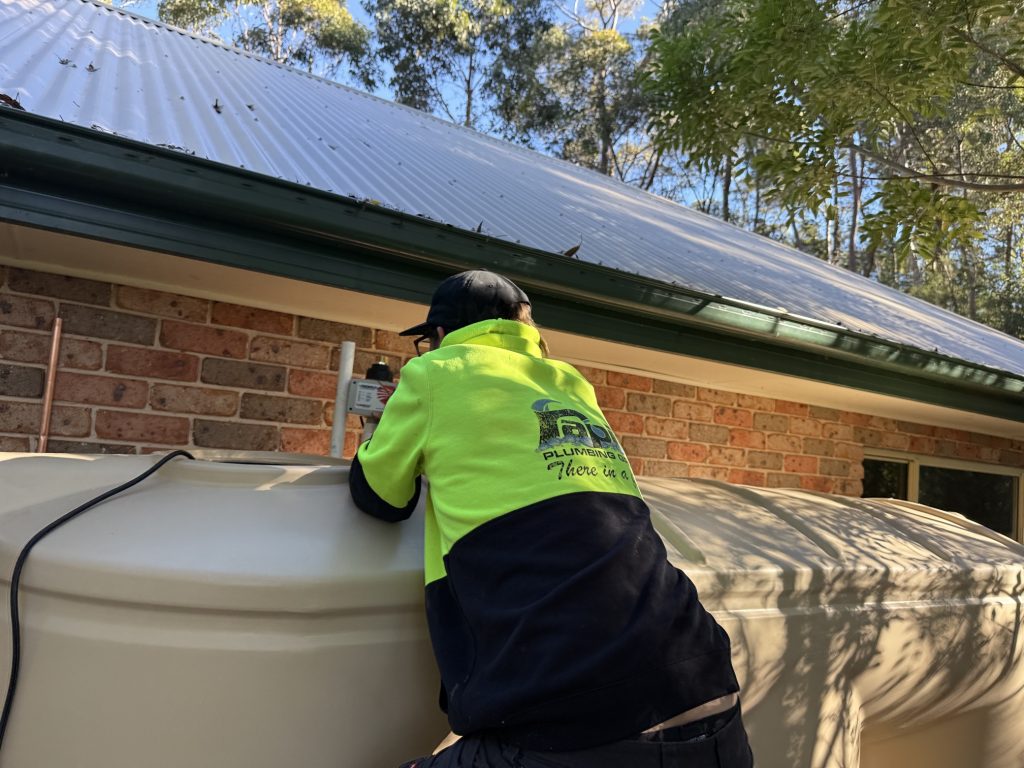
Rainwater arrives reasonably clean. What it picks up on the way into storage is another matter. Between the sky and your tap it crosses a roof, runs through gutters, travels down a downpipe, enters a tank, sits there for weeks, and then gets pumped out again. Every one of those stages is a decision made during rainwater tank installation, and every one can either protect the water or quietly spoil it.
That is why two households in the same street end up with completely different results. One tank delivers clear, odourless water year after year. The other develops a green tinge, a musty smell, or a sediment layer that clogs the pump. The rain falling on both roofs was identical. The installation was not.
Around Quakers Hill and the wider Blacktown area, tanks are common on newer builds, partly because BASIX water targets in New South Wales often make a rainwater tank the practical way to hit the required score. Plenty of those tanks were installed to satisfy a certificate rather than to produce good water for the next twenty years, and that gap is where most of the problems below come from.
| Still weighing up whether a tank suits your place? Work through the roof size, the site and the intended use before anyone quotes you on hardware. Our guide to the key things to consider before a water tank installation is a good starting point. |
Mistake 1: Harvesting from a roof nobody inspected
The catchment is the part of the system most installers never look at properly, and it is the part that determines what ends up in the water.
Not every roof is a good collection surface. Older homes may still carry lead flashing around chimneys and penetrations, or lead-based paint on trim near the gutter line, and some older coatings and tar-based repairs can leach into runoff. Colorbond and unpainted metal roofs are generally the most straightforward. Tiled roofs work fine but shed more grit and moss debris. If the roof has been repaired or recoated at some point, it is worth knowing with what before you plumb it into a household supply.
Roof-mounted equipment matters just as much. Evaporative air conditioners, wood heater flues, solar hot water units and antennas all sit in the catchment, and flue soot, cooler bleed-off water and bird droppings around a favourite perch wash straight into the downpipe. Health guidance generally recommends excluding runoff from roof areas affected by this kind of equipment, which usually means feeding the tank from a different section of roof rather than trying to filter the problem out later.
Then there are the trees. Leaf litter is the single biggest source of organic load in a tank. It rots, it feeds bacterial growth, and it produces the earthy smell people describe when they finally open the hatch. Gutters that fall the wrong way, or that were never adjusted after a roof restoration, hold water and debris permanently. That same debris shows up downstream, which is why leaves building up in stormwater drains and poor tank water so often turn up at the same house. Gutter guard helps, but it is no substitute for trimming back overhanging branches.
Mistake 2: No first flush diverter and no screens
These components cost very little relative to the tank itself, and skipping them is probably the most common shortcut in the trade.
The first flush diverter
The first water off a roof after a dry spell carries the highest concentration of dust, bird droppings, insects and general grime. A first flush diverter captures that initial volume and holds it out of the tank, releasing it slowly through a small outlet so the chamber is empty and ready for the next fall.
Two things go wrong. The first is that the diverter is never fitted at all. The second, and more common, is that it is fitted and then forgotten. The slow release outlet blocks with sediment, the chamber stays full, and from that point every drop of dirty first flush water bypasses straight into the tank. A diverter that has not been checked in three years is doing nothing. Sizing matters too, since the right diverted volume depends on the roof area feeding it and how dirty that roof gets, so have a plumber size it rather than fitting whatever came in the box.
Screens, mesh and light
Every opening into a tank needs fine, corrosion-resistant mesh: the inlet, the overflow and any vent or hatch. Mesh in the order of one millimetre aperture is commonly specified to keep mosquitoes out, though it is worth confirming what your council and the tank manufacturer require. An unscreened overflow is an open door. Mosquitoes breed in the tank, frogs and skinks get in and cannot get out, and rodents follow. A dead animal in a tank is not a hypothetical, and it will contaminate the entire volume.
Light is the other one people miss. Sunlight entering through a translucent tank wall, a poorly seated lid, an unsealed inspection hatch or a length of clear pipework is all algae needs. Once a tank goes green it tends to keep going green, and the fix is usually a clean-out rather than a filter.
| Not sure whether your existing tank was set up correctly? A licensed plumber can inspect the diverter, screens, seals and outlet position and tell you what is actually happening inside. See our rainwater tank and pump repairs and installation service, or call 02 9158 3597 to talk it through. |
Mistake 3: Drawing water from the wrong part of the tank
Sediment settles. Over time every tank develops a sludge layer at the base made up of fine grit, decomposed organic matter and whatever the diverter did not catch. That layer is relatively harmless as long as it stays undisturbed.
The mistake is placing the draw-off outlet too close to the tank floor, so every time the pump kicks in it stirs and pulls from exactly the layer you want to leave alone. Households in this situation report cloudy water, a taste change, and pump strainers and filter cartridges needing replacement far more often than they should. The fix is straightforward: position the outlet clear of the base so the sludge sits below it, or fit a floating offtake that draws from just below the water surface, generally the cleanest water in the tank.
Two related oversights are worth naming. The first is leaving no practical access for cleaning, because tanks need desludging eventually and a hatch that is sealed shut, jammed against a fence or buried under a deck means that job either costs a fortune or never happens. The second is an unlevel or inadequate base. Tanks are enormously heavy when full, and a base that is not level, compacted and built to the manufacturer’s specification lets the tank settle unevenly, stressing the walls and outlet fittings until cracks and weeping joints let groundwater, insects and light in.
It is also worth flushing a new tank before it goes into service. Offcuts, swarf, pipe shavings and solvent cement residue left behind during installation do not belong in the first tankful you use.
Mistake 4: Connecting a mains top-up without backflow protection
This is the mistake that stops being a nuisance and starts being a genuine risk. Many households want a mains top-up so the tank never runs dry, or rainwater plumbed to toilets, laundry and outdoor taps with mains as a backup. Both are reasonable, and both create a connection point between a non-drinking supply and the drinking water network.
Without an approved backflow prevention arrangement, a pressure drop in the mains can draw tank water backwards into the potable supply, which is a problem for your household and potentially for your neighbours. Sydney Water and the New South Wales plumbing rules require an approved arrangement on any such connection, generally either a registered air gap or a suitable backflow prevention device, and the work must be carried out by a licensed plumber. Which device applies depends on the configuration, so this is a conversation to have with your plumber rather than a decision to make in a hardware aisle.
Two compliance points get skipped on DIY and cash-job installations. Non-drinking pipework and outlets need to be identified so the next person working on the house, or a tenant, knows what they are dealing with. And a licensed plumber issues a certificate of compliance for the work, without which you have no record that the installation ever met the standard, which becomes a problem at sale or insurance time.
Backflow prevention, testing and device maintenance sit within our general plumbing services, and it is worth confirming the arrangement on an existing tank if you have never seen paperwork for it.
Mistake 5: Overflows and wet lines that never drain
A tank overflow needs somewhere to go. Left to discharge at the base of the tank, it keeps the ground permanently saturated, which undermines the base, attracts mosquitoes, and can let water pool back around the outlet fittings. The overflow should be screened, sized to handle the full inflow the roof can produce in heavy rain, and directed to stormwater or another appropriate discharge point clear of the tank and the house footings. Undersizing matters during the intense summer downpours Western Sydney gets: if the overflow cannot keep up, water backs up and finds another way out, usually through the hatch or the inlet screen.
Where the tank sits away from the downpipes, the connecting pipework often runs underground and rises into the tank. These charged lines stay permanently full between rain events. Water sitting in a sealed underground pipe for weeks in a Sydney summer goes stagnant, and that stagnant slug is the first thing pushed into the tank the next time it rains. A properly designed charged system includes a drain or flush point at its lowest position so the line can be emptied periodically. Installations without one leave you no way to deal with the problem short of digging.
What a properly installed system looks like in Quakers Hill
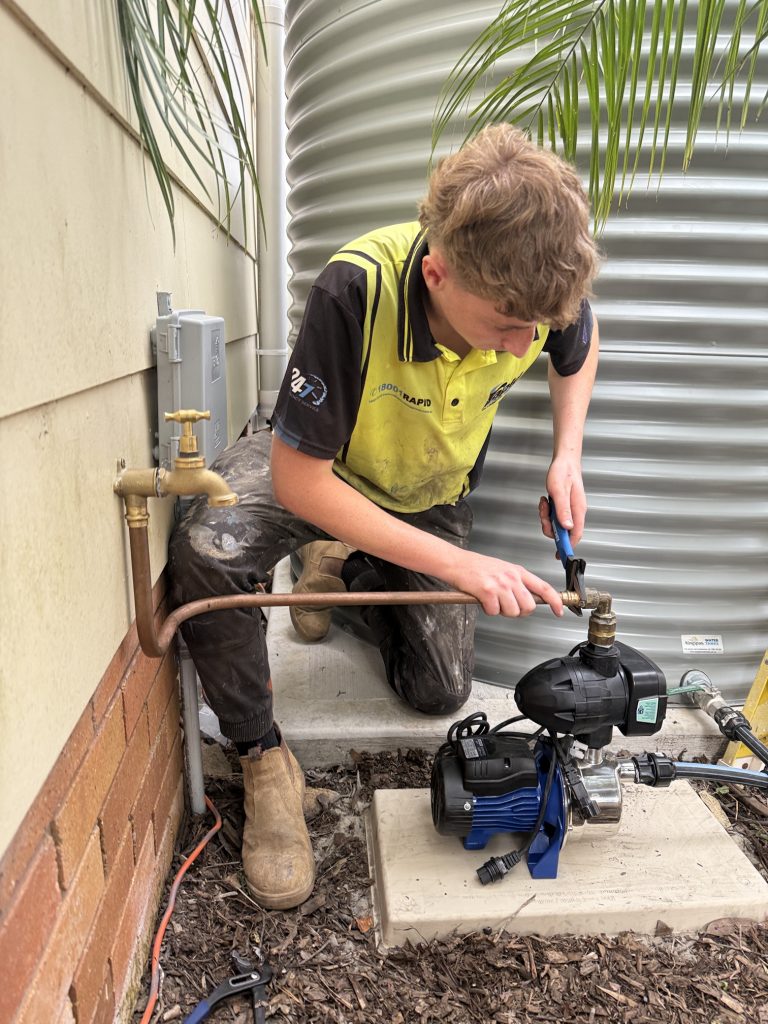
Pulling that together, a rainwater tank installation worth paying for covers the whole path the water takes, not just the tank sitting on the slab.
Key takeaways:
- The roof catchment is assessed for materials, coatings, roof-mounted equipment and overhanging trees before anything is connected.
- A correctly sized first flush diverter is fitted, with a plan for keeping its slow release outlet clear.
- Every inlet, overflow, vent and hatch is screened with fine corrosion-resistant mesh, and the tank is fully opaque and sealed against light.
- The draw-off point sits clear of the sludge layer, or a floating offtake is used, and the hatch stays accessible for future cleaning.
- The base is level, compacted and built to the manufacturer’s specification.
- Any mains top-up or connection to internal plumbing includes approved backflow prevention, with pipework and outlets identified and a certificate of compliance issued.
- The overflow is screened, adequately sized and directed away from the tank base, and any charged line has a drain point.
One point on drinking water. Where a reticulated mains supply is available, as it is across Quakers Hill, health authorities generally recommend using mains water for drinking and cooking and reserving rainwater for toilets, laundry, garden and outdoor use. If you do want to drink your rainwater, treat filtration and disinfection as part of the system design rather than an afterthought. Tanks also pair well with other water efficiency upgrades a plumber can install, which is often where the real bill savings come from.
Whatever the use, the system needs occasional attention. Adding the tank to an annual plumbing maintenance checklist alongside your gutters, hot water unit and drains is the simplest way to make sure the diverter, screens and pump strainer actually get looked at.
| Get your rainwater tank installed properly the first time. Local Quakers Hill Plumber is a family owned, fully licensed team working across Quakers Hill and the surrounding Blacktown suburbs. We handle tank and pump installation, backflow protection, diverter and screen upgrades, and repairs to existing systems that were never set up correctly.Call 02 9158 3597 to book an inspection or quote, or get in touch through our contact page. You can also see the full range of work we do across Quakers Hill and nearby suburbs. |
Frequently asked questions
Do I need a licensed plumber for a rainwater tank installation?
For a standalone garden tank fed by a downpipe with no connection to your household plumbing, the requirements are lighter. As soon as the tank connects to internal plumbing, or takes a mains top-up, the work is licensed plumbing work in New South Wales and must be carried out by a licensed plumber who can issue a certificate of compliance. It is also worth checking approval requirements with your local council, which for most Quakers Hill addresses is Blacktown City Council.
Why does my rainwater smell bad?
An earthy or musty smell usually points to organic matter breaking down in the tank, most often leaf litter that made it past the screens and diverter. A rotten egg smell suggests anaerobic conditions in the sludge layer or in a charged line that never drains. Either way the cause sits upstream of the tap, so a filter rarely fixes it for long.
How often should a rainwater tank be cleaned or desludged?
No single interval suits every site, because it depends heavily on the roof, the surrounding trees and how well the diverter and screens are working. A reasonable approach is a visual inspection of the inlet, screens, diverter and water surface once a year, with a desludge when the sediment layer starts approaching the outlet. Tanks under heavy tree cover generally need attention sooner.
Can I drink rainwater from my tank in Quakers Hill?
Where mains water is available, health authorities generally recommend using it for drinking and cooking. Rainwater can be used for drinking in some circumstances, but it depends on the catchment, the tank condition, and appropriate filtration and disinfection being in place and maintained. If drinking the water is your goal, design the system around that from the start.
Can a badly installed tank be fixed, or do I need to start again?
Most of the mistakes covered here are correctable without replacing the tank. Diverters can be retrofitted, screens replaced, outlets repositioned or converted to a floating offtake, overflows redirected, and backflow protection brought up to standard. The exceptions tend to be a failing base or a cracked tank, where the cost of repeated repairs can approach replacement.