Rainwater Tank Installation Costs: Tank, Pump, Plumbing and Base
| Quick answer: A rainwater tank installation is really four costs stacked together: the tank, the base it sits on, the pump and switching gear, and the plumbing that connects it all. Published 2026 Australian cost guides put a basic external, garden-only setup in the rough range of $1,000 to $3,000, while a fully integrated system with a pump, filtration and internal connections to toilets or laundry commonly lands between $3,000 and $6,000 or more. In NSW, any tank plumbed into household fixtures or topped up from mains must be installed by a licensed plumber, so the plumbing portion is not optional on those jobs. |
On this page
- The four costs hiding inside one quote
- Cost 1: The tank itself
- Cost 2: The base or slab
- Cost 3: The pump and switching gear
- Cost 4: The plumbing connection
- What NSW rules add to the bill
- How to compare two quotes fairly
- Frequently asked questions
Why the quotes you are getting look nothing alike
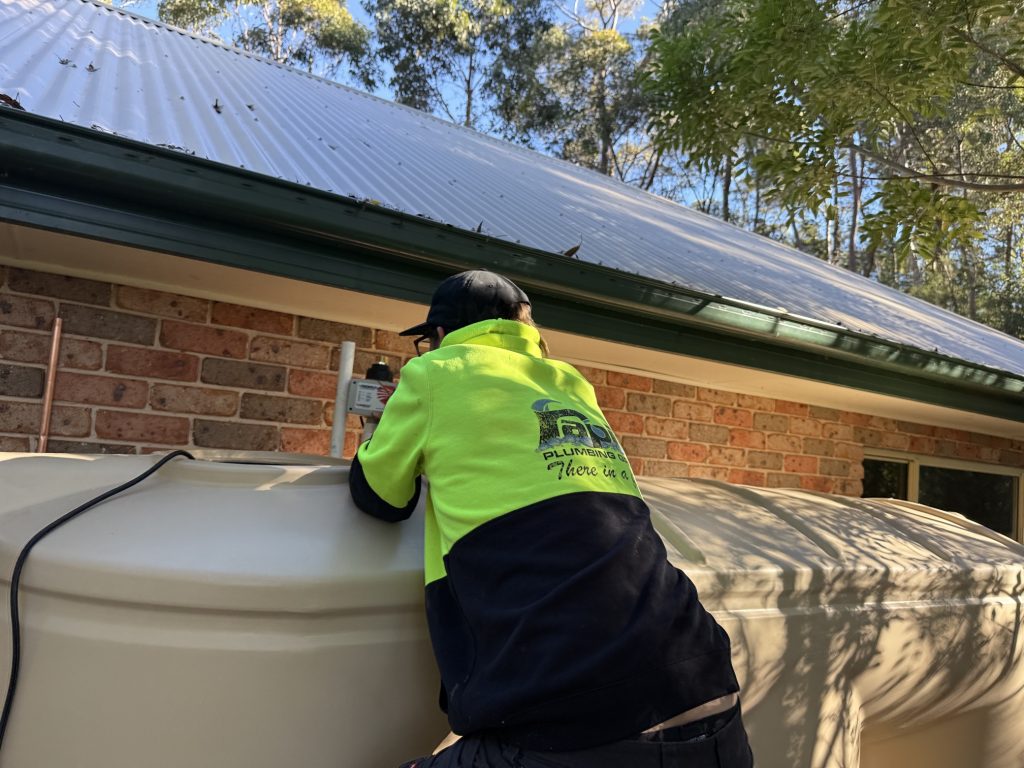
You ask three plumbers what a rainwater tank installation will cost and you get three numbers that seem to belong to different jobs entirely. One quotes low. One quotes triple that. The third wants to look at the property before saying anything at all. None of them are necessarily wrong.
The spread happens because rainwater tank installation is not one purchase, it is four, and different quotes include different combinations of them. Until you know which of the four you are being quoted on, comparing prices is guesswork.
This guide breaks the job into its four real cost centres so you can read any quote properly, spot what has been left out, and work out what your own place in Quakers Hill is likely to need. Where numbers appear, they are indicative ranges from published Australian cost guides, not a quote for your property.
| Still working out whether a tank suits your block? Have a read through our guide on the things to consider before a water tank installation for the practical questions worth settling before you shop for a tank. |
The four costs hiding inside one quote
Nearly every rainwater tank installation cost breaks down into these components:
- The tank. The vessel itself, plus delivery.
- The base. The level, load-bearing foundation underneath it.
- The pump and switching gear. What gives you usable pressure, and what keeps the taps running when the tank empties.
- The plumbing. Downpipe work, the first flush diverter, the pipe runs to whichever fixtures you are feeding, backflow protection and compliance paperwork.
A tank retailer’s advertised price generally covers the first item only. That is the single most common reason a cheap-looking quote grows once work starts. Read on for what each piece involves.
Cost 1: The tank itself
Tank price is driven by capacity, material and shape. Poly (polyethylene) tanks are the volume seller in suburban Sydney because they are lighter to place and cheaper per litre. Steel and colorbond-style tanks cost more but suit some sites and aesthetics better. Slimline tanks carry a premium over round tanks of the same capacity, because you are paying for the footprint, not just the water.
As a general shape of the market in 2026, published price guides show small garden tanks in the hundreds of dollars, mid-size household tanks around the low thousands, and larger rural-scale tanks climbing well beyond that. One widely cited 2026 guide puts the roughly 5,000 litre bracket, often described as the sweet spot for suburban homes and BASIX compliance, in the vicinity of $1,100 to $1,400, with 10,000 to 15,000 litre tanks more commonly in the $2,000 to $3,500 range.
Where people over-spend and under-spend
Two mistakes cost money. Buying on price alone is one: thinner-walled tanks with shorter warranties can be a false economy in Australian UV conditions. Buying capacity you cannot fill is the other, since your roof catchment area and local rainfall set a practical ceiling on how much you will actually collect. Check warranty length, material and whether delivery is included before comparing two tank prices side by side.
Cost 2: The base or slab
This is the line item most often forgotten, and the one with the worst consequences when it is skipped. Water is heavy. Roughly speaking, 1,000 litres weighs about a tonne, so a modest 5,000 litre tank sitting full is putting around five tonnes onto whatever is underneath it. If that surface settles unevenly, the tank can distort, stress its fittings and in bad cases fail.
The common options:
- Crusher dust or sand bed. Usually the most economical choice for large round tanks on stable ground, compacted and screeded level.
- Concrete pad. Generally recommended for slimline tanks and for tanks positioned near house foundations, because the narrow footprint concentrates load.
- Pre-made poly or composite base. Faster to install, higher upfront cost.
Cost here depends heavily on access and ground conditions. A flat backyard with a wheelbarrow path is a different job from a sloping block where machinery cannot get in. If your yard is tight, mention it when you request a quote, because access is one of the biggest swing factors in the final price.
Cost 3: The pump and switching gear
Gravity alone will run a garden hose at gentle pressure. It will not run a toilet cistern, a washing machine or an outdoor tap at the pressure you are used to. For anything beyond basic irrigation, you need a pump.
NSW-focused 2026 cost guides put pump supply and installation broadly in the $400 to $900 range for a standard residential setup, while other Australian guides quote $600 to $1,200 for an external pressure pump, with brand, capacity and installation complexity moving the number. Kits that bundle a pressure pump with a cover and a mains switchover device have been listed around the $730 mark, before any plumbing labour.
The switchover device is worth understanding
A mains switching device automatically flips your connected fixtures back to town water when the tank runs dry, then back to rainwater when it refills. Without one, an empty tank means a dead toilet cistern. It is an added cost, and for most connected-fixture installations it is the difference between a system you can forget about and one you have to babysit. Pump placement matters too, for reasons that never appear on an invoice: pumps make noise, and putting one under a bedroom window is a decision you only get to regret once.
| Not sure which parts of this job you actually need? Our rain water tank and pump installation service covers tank selection, pump sizing and the connection work, and we can walk your site with you before anything is ordered. Every itemised quote makes clear what is included and what is not. |
Cost 4: The plumbing connection
This is where a garden tank becomes a household water system, and where the price separates most sharply.
The plumbing scope typically covers the downpipe connection from your gutters into the tank inlet, a first flush diverter that sends the first dirty run of roof water away from the tank, the overflow discharge to stormwater, the pipe runs from the pump to your fixtures, and the mains backup arrangement. For NSW in 2026, published guides put tank connection work broadly in the $300 to $600 range and a toilet connection around $250 to $500, with first flush diverters commonly quoted between $150 and $400. Guides for other states run higher, which is a useful reminder that state-level figures are not interchangeable.
What drives the plumbing cost up
- Retrofit versus new build. A new build has open walls and no finished surfaces to work around. A retrofit means adapting existing downpipes and finding a route for new pipework through a finished house, which is consistently one of the larger cost drivers.
- Number of connected fixtures. Toilets only is one job. Toilets, laundry cold tap and external taps is another.
- Distance from tank to fixtures. Every metre of pipe and every obstacle between the two adds labour.
- Gutter and downpipe condition. A tank fed by blocked or poorly falling gutters will not fill properly. If your stormwater and drainage needs attention first, that is separate work worth pricing at the same time.
Call-out fees and hourly rates also feed into any labour-based line. Published Australian guides have put plumber call-out fees in the vicinity of $60 to $100 and hourly rates around $100 to $150, though these vary by operator and job type. We cover this in more detail in our guide to fair plumbing costs in Quakers Hill.
What NSW rules add to the bill
Compliance is not a line item most homeowners think about, but in NSW it shapes the job.
Approval. Sydney Water advises that tanks storing up to 10,000 litres do not normally need council approval, provided a set of conditions is met. Those conditions sit under the state’s exempt and complying development framework, and local councils can have their own requirements on top, so it is worth a call to Blacktown City Council before you commit to a position or a size.
Licensed work and inspection. Plumbing your tank into the house, or interconnecting it with mains water, must be done by a licensed plumber. Sydney Water also advises that your plumber books and pays for an inspection by NSW Fair Trading where a tank is connected to a toilet, washing machine or hot water system, or where it is topped up from or switched to the drinking water supply. Ask for your Certificate of Compliance when the work is finished, which certifies the plumbing meets the Plumbing Code of Australia.
Backflow prevention. Where rainwater and mains water can meet, backflow protection matters, and a property-specific device may be required. This protects the drinking water supply, and it is not somewhere to economise.
BASIX. If your tank is part of a new build or a significant renovation, your BASIX certificate will specify tank size, connected fixtures and roof catchment area. Those commitments have to be met as written, and changing them after certification is an administrative process, not a site decision. If you are mid-project, confirm the certificate details before ordering a tank.
How to compare two quotes fairly
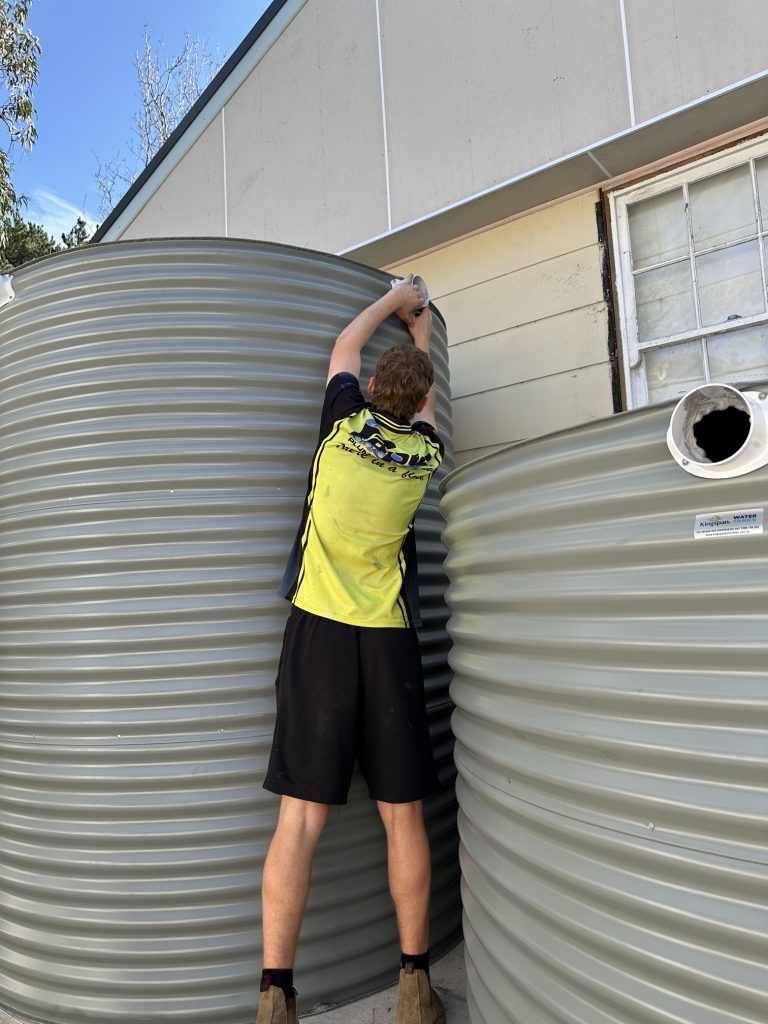
Once you understand the four cost centres, comparing quotes gets much simpler. Ask each quote to state, explicitly:
- Tank capacity, material, warranty length, and whether delivery is included
- Base type, and who supplies and prepares it
- Pump make and capacity, and whether a mains switchover device is included
- Exactly which fixtures are being connected
- Whether a first flush diverter and backflow protection are included
- Whether the Fair Trading inspection and Certificate of Compliance are covered
- What happens to the tank overflow
A quote that answers all seven can be compared to another that answers all seven. A single bottom-line number cannot be compared to anything.
Key takeaways
- The advertised tank price is usually the smallest part of a connected installation.
- The base is not optional, and full tanks are heavier than most people picture.
- A pump is required for anything beyond gentle gravity-fed garden use.
- Internal connections in NSW require a licensed plumber, and often a Fair Trading inspection.
- Retrofits generally cost more than the same system in a new build.
- Published ranges are a budgeting starting point. Only a site assessment produces a real figure.
For a broader view of what else is worth checking around the property while a plumber is on site, our Quakers Hill homeowner’s plumbing checklist is a useful companion read, and our general plumbing services page covers the day to day work we handle alongside tank installations.
Frequently asked questions
How much does rainwater tank installation cost in total?
Published Australian guides suggest a basic external, garden-focused installation commonly falls somewhere around $1,000 to $3,000, while an integrated system with a pump, filtration and internal connections to fixtures typically runs from about $3,000 to $6,000 and can exceed that on complex sites. Your figure depends on tank size, base type, pump specification, how many fixtures are connected and how difficult the site access is.
Do I need council approval for a rainwater tank in Quakers Hill?
Sydney Water advises that tanks up to 10,000 litres do not normally need council approval provided a set of conditions is met, but those conditions matter and councils can impose local requirements. Check with Blacktown City Council for your specific property, particularly regarding tank position, size and setbacks, before you order anything.
Can I install a rainwater tank myself?
For a standalone tank feeding a garden tap only, many handy owners handle the tank and base themselves. The moment the tank is plumbed into household fixtures such as toilets, laundry or hot water, or connected to the mains supply, the work must be carried out by a licensed plumber under NSW requirements, and an inspection may apply.
What size rainwater tank do I need?
It depends on your roof catchment area, what you intend to connect, and your household use. Around 5,000 litres is a common suburban choice and is frequently the size specified for BASIX compliance on new homes. If your tank is tied to a BASIX certificate, the size is set by that certificate rather than by preference.
How long does a rainwater tank installation take?
A straightforward garden tank on a prepared base can often be completed within a day. A connected system involving base preparation, pump installation, internal plumbing runs and an inspection generally spans several days, and can be longer if the base needs to cure or if access is restricted.
Are there rebates for rainwater tanks in NSW?
Rebate and incentive programs change over time and vary by state and council, and eligibility often depends on tank size and how the tank is connected. Check the current position with Blacktown City Council and the relevant NSW agencies before budgeting on a rebate, rather than assuming one applies.
| Get a real number for your property. Ranges in a cost guide can only take you so far. A site visit tells you what your base needs, what pump suits the run, and what the connection will actually involve. Call Local Quakers Hill Plumber on 02 9158 3597 for an itemised rainwater tank installation quote, or get in touch through our contact page. We are licensed, available 24/7, and we work across Quakers Hill and the surrounding suburbs. |