Leak Detection Quakers Hill: Acoustic, Thermal and Pressure Testing Compared
| Quick answer: Leak detection in Quakers Hill generally uses three methods, and good plumbers combine them rather than relying on one. Acoustic detection uses sensitive microphones to hear pressurised water escaping through a pipe wall, which makes it the best tool for slab leaks and buried water lines. Thermal imaging reads surface temperature differences, so it excels at tracing hot water leaks and mapping how far moisture has spread behind tiles and plasterboard. Pressure testing isolates a section of pipework and watches whether it holds pressure, which proves a leak exists and narrows down which line it is on. Acoustic and thermal find the leak, pressure testing confirms it. |
On this page
- Why leaks hide so well in Quakers Hill homes
- Acoustic leak detection: listening for the escape
- Thermal imaging: reading temperature, not water
- Pressure testing: proving the leak is real
- Leak detection Quakers Hill: the three methods compared
- What a leak detection visit looks like
- Signs you should book leak detection now
- Frequently asked questions
The leak you can hear is rarely the expensive one

A dripping tap announces itself. A leak inside a wall cavity, under a concrete slab or beneath the front lawn does the opposite. It works quietly for weeks, and the first hint is usually a water bill that does not match how you have been living, or a patch of carpet that feels cold underfoot. By then the water has been travelling somewhere it should not, and the repair has grown well beyond the cost of the pipe itself.
This is why leak detection in Quakers Hill is about more than confirming water is escaping. The goal is to pinpoint where, so the repair opens the smallest possible area of slab, wall or garden. A plumber who guesses cuts a metre of concrete. A plumber who locates cuts a hand span.
The three tools that do most of that work are acoustic detection, thermal imaging and pressure testing. They are not competing options where one is simply better, and knowing what each is good at tells you whether your plumber is working methodically or hoping for luck.
| Not sure you have a leak yet? Start with the symptoms. Our guides on a soggy patch in the front yard and sudden drops in water pressure walk through the early warning signs, no appointment needed. |
Why leaks hide so well in Quakers Hill homes
Housing around Quakers Hill, Acacia Gardens, Schofields and The Ponds skews towards slab-on-ground construction, which is efficient to build but unforgiving when a water line under the concrete fails. There is no subfloor to crawl into and no visible run of pipe to inspect. Water leaving a pipe under a slab follows whatever path is easiest, often sideways along the bedding sand for several metres before it surfaces, so the wet spot on your floor is frequently nowhere near the actual break.
Reactive clay soils across parts of Western Sydney add another layer, since ground that swells when wet and shrinks when dry puts steady stress on rigid pipework and on joints that were fine for years. Older copper can corrode from the outside in where it sits in damp soil. None of this is dramatic, and slow is what makes a leak expensive.
Vertical plumbing hides even better. A leak behind a shower wall may show up two rooms away as a swollen skirting board or bubbling paint. If that sounds familiar, our post on shower leaks behind tiles covers how to tell a waterproofing failure from a genuine plumbing fault, because the two need very different repairs.
Acoustic leak detection: listening for the escape
Acoustic detection is the workhorse of concealed leak location. When water under pressure escapes through a small opening, it creates vibration and noise that travels along the pipe wall and through the surrounding material. Far too faint for human ears through concrete or soil, it sits well within range of a ground microphone and amplifier.
The plumber places sensors at intervals across the suspected area and listens for where the signal is loudest. Move closer and the sound sharpens. Move away and it fades. Working a grid, the technician converges on a point and marks it on the floor or lawn.
What it does best
- Pressurised water lines. Mains, cold and hot runs all work, because the method depends on pressure rather than temperature.
- Under-slab leaks. The main reason to reach for acoustic gear, since it locates a fault without breaking a single tile first.
- Buried service lines. A leak between the water meter and the house is a classic acoustic job, because digging blind across a front yard is nobody’s idea of a good afternoon.
Where it struggles
Acoustic detection needs pressure and relative quiet, so it is not the tool for a drainage or sewer fault, and background noise from traffic or air conditioning can mask a faint signal. Very deep pipes, thick reinforced slabs and certain plastics dampen the sound enough to make a reading ambiguous. A rapid pressure loss is also easier to find than a pinhole that has been seeping for two years, which is the opposite of what most people expect. If things have already escalated, our guide to slab leak emergencies explains what changes when the pipe is under your foundation.
Thermal imaging: reading temperature, not water
Thermal cameras do not see water and they do not see through walls, which is the most common misunderstanding about them. What they see is infrared radiation coming off a surface, translated into a temperature map. A leak becomes visible because escaping water changes the temperature of the material around it, and that change eventually reaches the surface.
Two effects make this useful. Hot water leaking under a floor warms the slab above, producing a bright plume that often traces the line of the pipe. Cold water soaking into plasterboard cools the surface through evaporation, producing a darker patch with a soft edge that a trained eye can separate from a shadow or a stud.
What it does best
- Hot water line leaks. The temperature contrast is strong, making these among the easiest concealed leaks to see.
- Mapping the spread. It shows how far moisture has migrated, which tells you how much flooring or plasterboard is genuinely affected.
- Fast scanning. A technician can sweep a room in minutes without touching anything, narrowing the search area before slower methods begin.
Where it struggles
Thermal imaging is indirect evidence. A cool patch might be a leak, or a cold water pipe doing its job, a poorly insulated wall, or a surface that has been in shade. Tiles, carpet and insulation all blur the signal, and cold water leaks in an already cold room produce very little contrast. A thermal image on its own is a lead, not a diagnosis, and any plumber cutting into a wall on the strength of one picture is moving too fast.
| Comparing plumbers before you book? Ask what detection equipment they carry, whether the detection fee is separate from the repair, and what they do if the first method comes back inconclusive. Local Quakers Hill Plumber is happy to answer all three before you commit. See our general plumbing services, or send us what you are seeing and we will tell you what we would check first. |
Pressure testing: proving the leak is real
Pressure testing answers a different question. Rather than asking where the leak is, it asks whether one exists and on which line. The plumber isolates a section of pipework, brings it to a set pressure with a test gauge, shuts it off and watches. Sound pipework holds. Faulty pipework loses pressure, and the rate of loss hints at the size of the opening.
The real power is in isolation. By closing valves and testing sections separately, the hot line can be cleared while the cold line is implicated, or the irrigation circuit ruled out entirely. That halves or quarters the search area before anyone picks up a microphone, and a gauge that drops is objective in a way a damp patch is not.
The limitation is precision. A pressure test tells you the cold line under the western half of the house is losing pressure, not that the leak sits two metres in from the wall. It also needs working isolation points, and on older or heavily modified systems those valves sometimes do not exist or no longer seal. Pressure testing is equally what a plumber uses after a repair to verify the fix held, which is the difference between a repair that is finished and one that merely looks finished.
Leak detection Quakers Hill: the three methods compared
| Method | What it measures | Best suited to | Main limitation |
| Acoustic detection | Sound and vibration from water escaping a pressurised pipe | Slab leaks, buried mains, concealed pressurised lines | Needs pressure and low background noise, and does not work on drains |
| Thermal imaging | Surface temperature differences caused by moisture or hot water | Hot water leaks, mapping how far damp has spread, fast area scanning | Indirect evidence, with weak contrast on cold water and through thick coverings |
| Pressure testing | Whether an isolated section of pipe holds a set pressure | Confirming a leak, ruling lines in or out, verifying a completed repair | Confirms and narrows, but does not pinpoint a location |
Read across that table and the sequence suggests itself. Pressure testing narrows the field, thermal imaging scans the narrowed area, acoustic detection lands on the point. Not every job needs all three, but a concealed leak with no obvious source usually benefits from at least two methods agreeing before anything gets cut open.
What a leak detection visit looks like
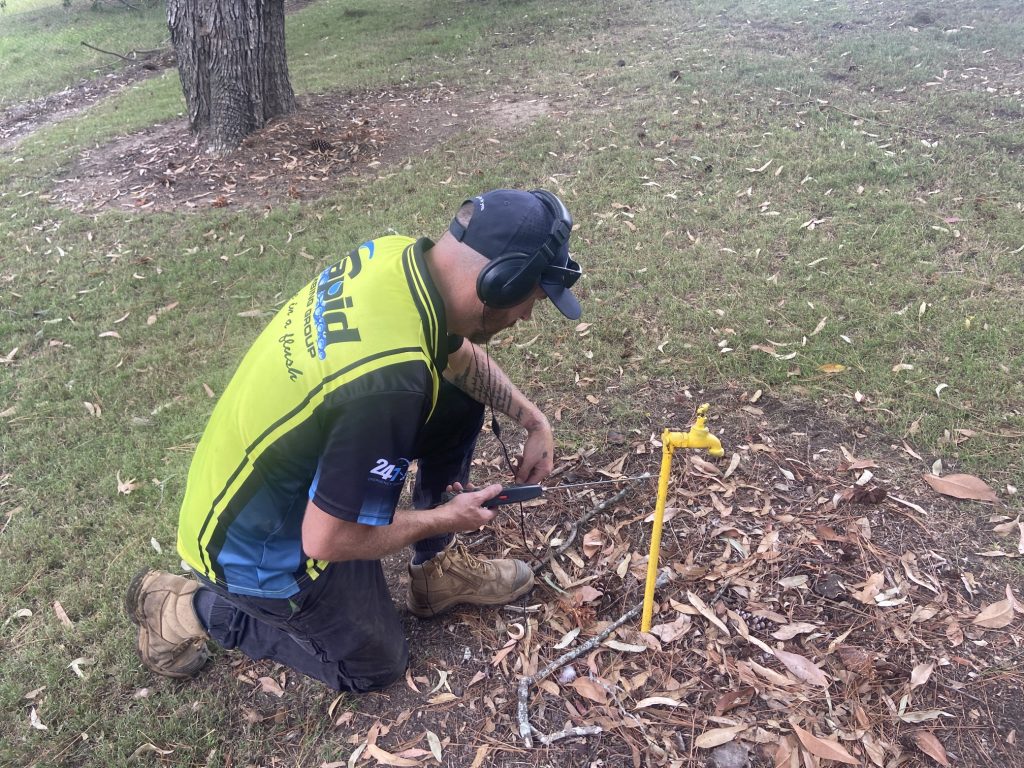
Much of the work happens before any equipment leaves the van. A useful sequence looks like this:
- Conversation and history. When you noticed it, what changed, what has been renovated. Context routinely saves an hour of searching.
- The meter test. Turn off every fixture and watch the meter. Continued movement is strong evidence of a leak on the property side.
- Visual inspection. Under sinks, around the hot water unit, along fence lines, in the roof space. Some leaks are found here.
- Isolation and pressure testing. Narrow the fault to a specific line or zone.
- Thermal sweep. Scan the implicated area for anomalies.
- Acoustic pinpointing. Converge on the exact spot and mark it.
- Repair recommendation. What is involved, what access is needed, and whether a section needs replacing rather than patching.
Timing varies. A localised hot water leak might be pinned down inside an hour, while a slow under-slab weep on a noisy street takes considerably longer. An honest plumber will say so rather than rush the diagnosis and guess at the excavation point.
Signs you should book leak detection now
Any single item below is worth a phone call. Two or more together makes it urgent, because concealed water compounds.
- Your water bill has stepped up without a matching change in household use.
- The meter keeps moving when every tap and appliance is off.
- Warm or oddly cold patches appear on the floor, particularly on a slab.
- A section of lawn stays wet or unusually green when the rest is dry.
- You can hear running or hissing water when nothing is in use.
- Musty smells, bubbling paint, swelling skirting boards or lifting flooring.
- Water pressure has dropped across the whole house rather than at one tap.
Key takeaways
- Acoustic detection finds the point, and is the primary tool for slab and buried pressurised leaks.
- Thermal imaging finds the area and maps the damage, and is strongest on hot water faults.
- Pressure testing proves the leak exists, isolates the line, and verifies the repair afterwards.
- No single method suits every leak, and methods that agree produce smaller, cheaper repairs.
- Acting on early signs generally costs far less than waiting for visible damage.
| Suspect a hidden leak? Book leak detection with Local Quakers Hill Plumber on (02) 9158 3597. We service Quakers Hill and the surrounding suburbs, carry acoustic and thermal equipment, and pressure test before we cut anything so the repair stays as small as possible. If water is actively causing damage right now, go straight to our 24/7 emergency plumbing service, or see everything we cover for Quakers Hill homes and businesses. |
Frequently asked questions
How much does leak detection in Quakers Hill cost?
Pricing depends on the size of the property, how much pipework can be isolated, and how many methods the job needs. A leak confirmed quickly with a meter test and a short acoustic sweep sits at the lower end, while a difficult under-slab fault across a large home takes longer. Ask for the detection fee and the likely repair range as separate figures, and check whether the detection fee is credited against the repair.
Can a plumber find a leak without breaking concrete or tiles?
Locating it, yes, in most cases. That is the whole purpose of acoustic and thermal equipment, and a competent detection job should identify the spot before anything is opened up. Repairing it is different. If the pipe sits under a slab, access will be needed, though pinpointing first means opening a small marked area instead of exploring blind.
Is thermal imaging enough on its own to find a leak?
Rarely. Thermal imaging shows temperature anomalies, and while a leak creates one, so do insulation gaps, draughts and pipes that are simply doing their job. It is excellent for narrowing the search and showing how far moisture has travelled, but the finding usually needs confirmation from acoustic detection or a pressure test before repair work starts.
Which method works for a leaking drain or sewer line?
None of these three directly. Acoustic detection relies on pressure that drainage lines do not carry, and pressure testing works differently on waste systems. Drain faults are normally investigated with a CCTV drain camera, sometimes with a locator to trace depth and path. If your symptoms are smells or slow drainage rather than a rising water bill, our blocked drains service is the better starting point.
Does home insurance cover a hidden water leak?
It depends on the policy and the cause. Many Australian policies cover the resulting damage from a sudden escape of water while excluding the failed pipe itself, and gradual deterioration is a common exclusion. Insurers usually want documentation of the detection work, so keep the report, images and invoice, and check your product disclosure statement since wording varies.
How quickly should I act on a suspected leak?
Soon. Beyond the wasted water, prolonged moisture can affect flooring, cabinetry, wall linings and, in some soil conditions, the ground supporting a slab. A leak caught early is often a simple repair on a short section of pipe, while the same leak six months later can involve replacing materials that were fine when it started.
Book leak detection in Quakers Hill
Hidden leaks do not settle down on their own. If the meter is ticking with the taps off, or the water bill has stopped making sense, a proper detection visit will tell you what is happening and where, before the damage spreads further.
| Call Local Quakers Hill Plumber on (02) 9158 3597. Licensed local plumbers offering acoustic and thermal leak detection, pressure testing, and repairs done properly the first time across Quakers Hill and Western Sydney, available 24/7 for emergencies. Prefer to write it down? Use our contact form and describe what you have noticed. |